Dropping a new built-in into an old opening
That a replacement built-in drops straight into the opening the old appliance came out of, and that a fit problem is only cosmetic.
Monday to Friday 8:00am – 6:00pm · Saturday 9:00am – 4:00pm
(904) 478-8963The igniter clicks continuously but the burner will not light, or lights then goes out
Causes are listed as symptoms and mechanisms, not part numbers. The actual fault is confirmed on site.
Gas smell means stop
Shut the supply, ventilate, and do not troubleshoot a burner you can smell.
Before anything else: if you can smell gas, turn the knob off, shut the supply valve behind or beneath the appliance, open a window, and leave the burner alone. Nothing on this page is worth doing in a room that smells of gas. Call your gas supplier first and a repair company second.
With that said, most burners that click without lighting are held up by something small and mechanical.
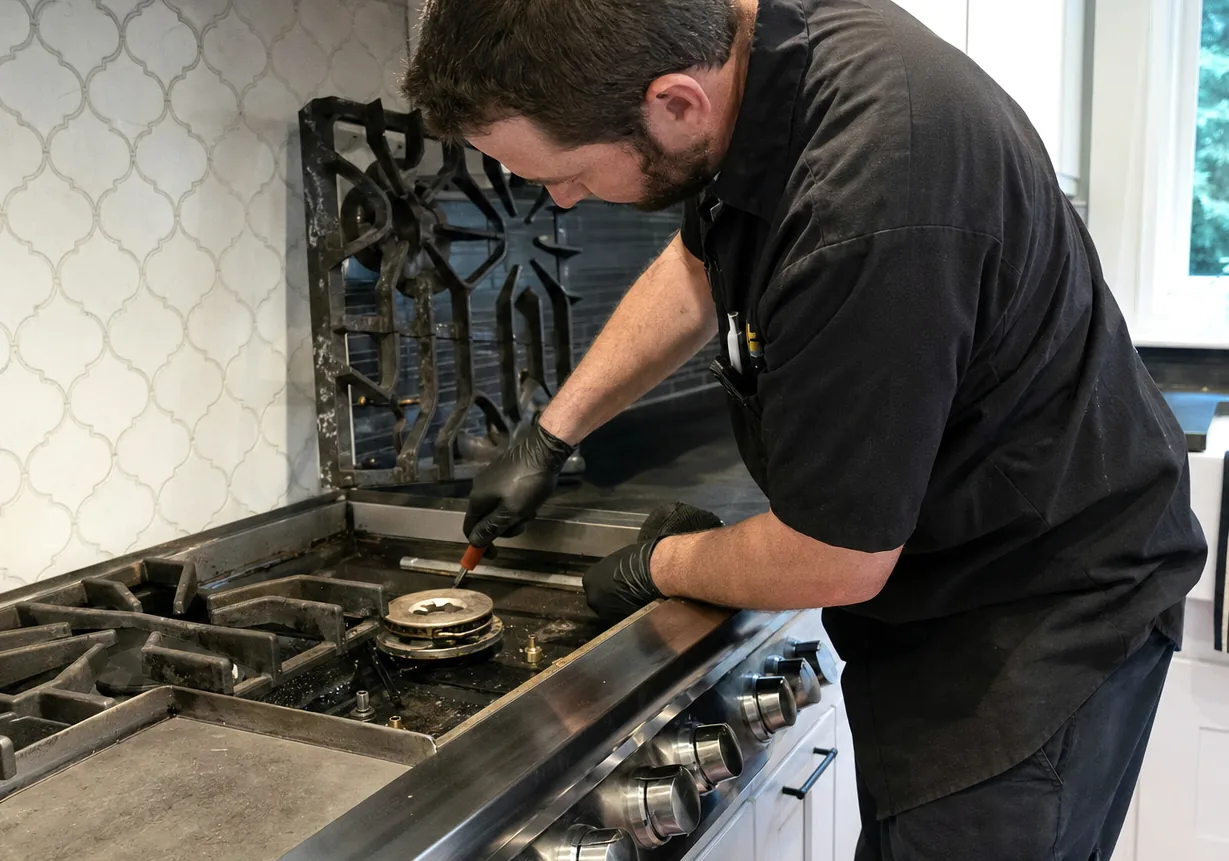
Thermador’s star-shaped burner ports depend on the cap sitting exactly on its locating step. After a clean, a cap that has been dropped back on at a slight angle sits proud on one side, and the gas leaving the port nearest the igniter no longer meets the spark. The burner clicks, you can hear gas, and nothing lights.
Lift each cap off, set it back deliberately, and feel for it dropping into its seat. A correctly seated cap does not rock when you press its edge. This single check resolves a large share of the calls that come in for this symptom.
Igniters sit in a small ceramic well that traps liquid. A boil-over, or a kitchen cloth wrung out over the cooktop, leaves enough moisture to short the spark to the burner body instead of jumping the gap to the gas. The behaviour is distinctive: continuous clicking on the wet burner, and often clicking on the other burners too, because the module fires all positions together.
Dry it properly. Leave the caps and heads off, leave the cooktop uncovered for an hour or two, and try again. In a humid Clay County summer that can take longer than you expect.
The ports are narrow by design — that is what produces the flame pattern — and they block with sugar, starch and burnt oil. A straightened paperclip or a thin pin will clear them. Never use a wooden toothpick, which breaks off in the port and leaves you worse off, and never enlarge a port with a drill bit.
Lift the head, look at the underside, and clear the venturi opening where it sits over the orifice. A partially blocked venturi produces a lazy yellow flame rather than a failure to light, so if your complaint is soot on the pans, that is where to look.
That is a different fault. A burner that lights while you hold the knob and dies when you release it is describing a flame-sensing problem. The sensor has to see flame and hold the safety valve open; when it no longer does, the valve closes and the burner dies within a few seconds. Cleaning the sensor tip carefully sometimes restores it. If it does not, the part is replaced rather than adjusted.
If every position clicks constantly with all knobs off, or no position clicks at all, the spark module or its wiring is the candidate rather than any individual burner. Note which of those two you have before booking — it points the visit in opposite directions.
Cleaning products and cooktop treatments. Nothing poured, sprayed or wiped onto the surface reaches the igniter well or the gas path. What a cleaning session does change is alignment and moisture: a cap lifted off and set back a few degrees out of position, or water left standing in the igniter well, accounts for a large share of these calls. If the burner stopped lighting the day the rangetop was cleaned, that is the fault, and it costs nothing to correct.
The flat $80 diagnostic covers a proper check of the igniters, the sensing circuit, the module and the gas path, with a written estimate before any work begins and the fee credited toward the repair. Genuine OEM parts, 90 days on labor, 365 days on parts. Scheduled appointments across Clay County, Monday to Friday and Saturday mornings.
$80 covers the diagnosis, and it is taken off the total if you decide to go ahead. Past that the figure is set by which component has actually failed, and the rows below are where a rangetop repair has been settling. Nobody here quotes one number before the panel is off.
| What has failed | Parts and labor |
|---|---|
| Diagnostic visit | $80 flat |
| Igniter, spark module or surface element | $210–$490 |
| Control board or touch panel | $440–$1,010 |
Ranges, not quotes. The width of a band is mostly access: a component reached from the front is one job, and the same component behind an appliance that has to come out of its opening is quite another. How a job is priced.
That a replacement built-in drops straight into the opening the old appliance came out of, and that a fit problem is only cosmetic.
That there is nothing useful an owner can do before a service visit except wait, and that a code on the display is the whole story.
Rated 4.5 out of 5 across 72 customer reviews. Read all 72.
Clicking with no flame on the large burner. The spark electrode had cracked at the ceramic and was arcing to the pan support instead of the gas. He replaced it, though I waited on the part longer than I expected to.
Ignatius O.August 2026
Two burners clicked continuously in the damp weather. He dried and resealed the igniters, which held, but he could not promise it will not return in the wet season and I would have liked a firmer answer.
Loretta N.July 2026
One burner lit at the back of the crown and nowhere else, so the pan heated on one side. He lifted the cap, found the ports part blocked by boil-over, cleared them and reseated it square. It has lit evenly since.
Clementine D.September 2026
Flat $80 diagnostic, credited toward the repair. Written estimate before any work begins. Serving Clay County.
Call (904) 478-8963